As we navigate the deeply interconnected and rapidly evolving global economy of 2026, the African continent stands at a critical historical crossroads. Africa boasts the youngest population on the planet, alongside one of the highest rates of female entrepreneurial activity globally. Yet, this staggering demographic dividend has historically been trapped in a paradox: immense human potential aggressively suffocated by a severe lack of financial liquidity. For decades, brilliant young minds and highly capable women have watched their ambitions wither, not due to a lack of intellect or work ethic, but simply because they could not access the capital required to purchase a laptop, lease a storefront, or pay for a university semester.
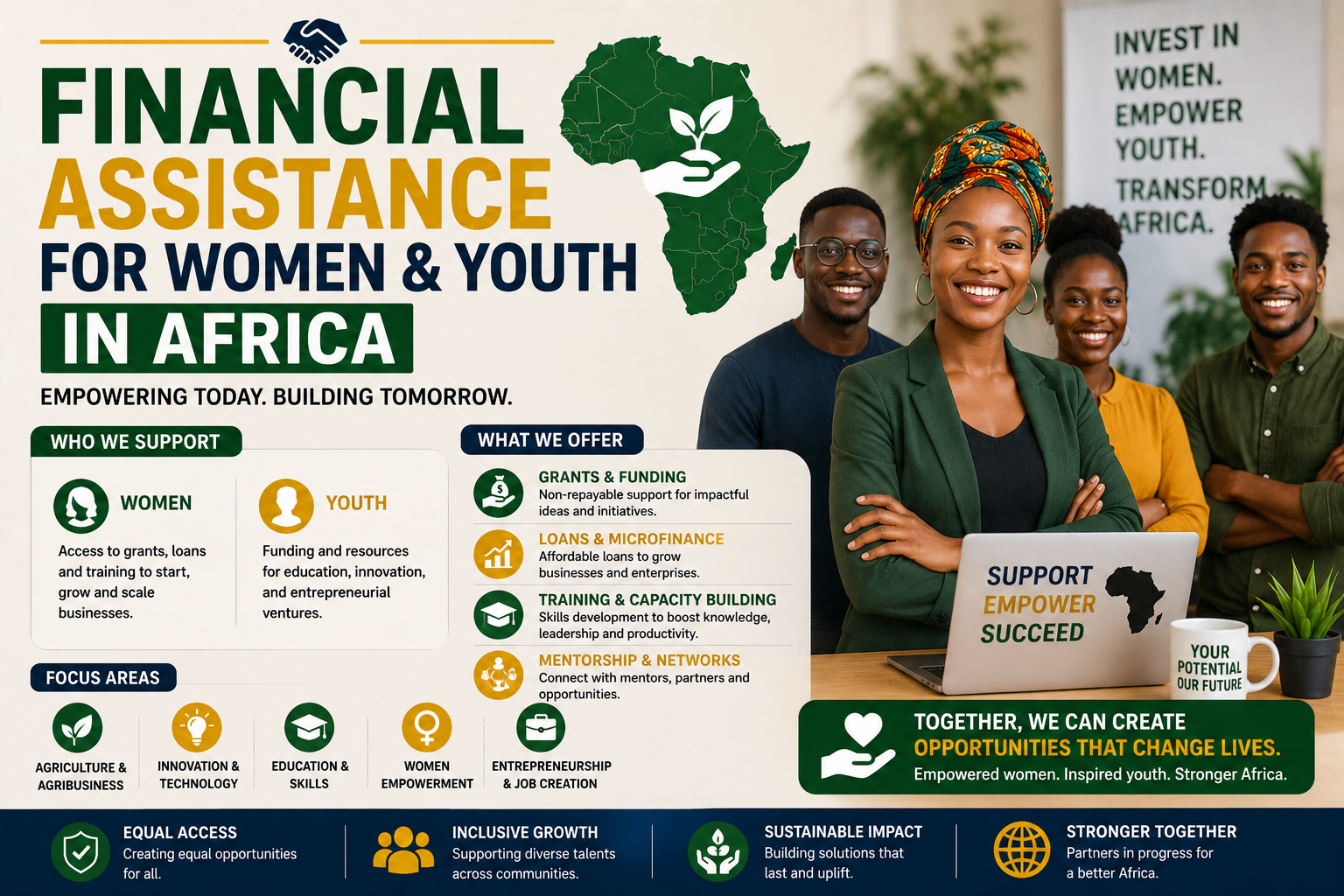
However, a magnificent paradigm shift is currently unfolding. Global economic strategists, multinational corporations, and sovereign African governments have collectively awakened to a fundamental mathematical truth: you cannot achieve continental prosperity while financially excluding the majority of your population. Consequently, an unprecedented tsunami of financial assistance—spanning grants, zero-interest loans, fully funded scholarships, and venture capital—is being aggressively deployed specifically to target African women and youth.
Despite this massive influx of capital, a heartbreaking reality persists. Millions of eligible individuals remain entirely unaware that this money exists, or they are deeply intimidated by the bureaucratic application processes required to access it. This definitive, exhaustive masterclass is designed to completely dismantle that barrier. We will forensically examine the current landscape of financial assistance across Africa, dissecting exactly where the capital is hidden, understanding the psychology of the institutions distributing it, and equipping you with the elite strategies necessary to successfully claim it.
### The Macro-Economics of Empowerment: Why Women and Youth?
Before you can successfully apply for funding, you must understand exactly *why* institutions are earmarking billions of dollars specifically for you. This is not charity; it is calculated economic strategy.
Economists have definitively proven what is known as the “Multiplier Effect.” When financial capital is placed into the hands of an African woman, she reinvests up to 90% of that income directly back into her family and immediate community—funding her children’s education, improving household nutrition, and expanding local micro-economies. When capital is placed into the hands of a young African innovator, they build technology that leapfrogs archaic infrastructure, creating digital jobs that did not exist a decade ago.
Therefore, when you approach an institution for funding, you must shift your mindset. You are not begging for a handout to survive. You are presenting yourself as a highly efficient, high-yield investment vehicle capable of executing their macro-economic development goals.
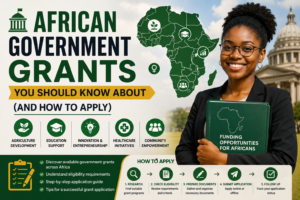
### 1. Sovereign Wealth: Navigating Government Financial Programs
National governments are acutely aware that youth unemployment is a ticking time bomb, and female financial exclusion actively suppresses national GDP. To counter this, governments from Nairobi to Lagos and Johannesburg are deploying massive sovereign funds.
**The Mechanics of State Funding:** Government programs typically manifest as Youth Enterprise Development Funds, Women’s Microfinance Banks, or localized state bursaries. These initiatives are designed to democratize capital at the absolute grassroots level. They frequently offer non-repayable startup grants to young artisans, heavily subsidized agricultural equipment to rural female farmers, and zero-interest loans to youth-led tech cooperatives.
**Navigating the Bureaucracy:** The primary challenge with government funding is administrative congestion. To win these funds, your legal compliance must be flawless. You must possess digitized copies of your national identity card, your tax clearance certificates, and your official business registration documents. Do not wait for a funding announcement to register your business; have your legal framework established today so you can strike the moment the government portal opens.
### 2. The Multilateral Titans: Global Organizations
Beyond national governments, the heavy lifting of African development is frequently financed by multilateral titans such as the United Nations (specifically UN Women and the UNDP), the World Bank, and the African Development Bank (AfDB).
**The Scale of Intervention:** These institutions do not typically hand out $500 micro-grants to individuals. They operate on a massive scale. For example, the AfDB’s Affirmative Finance Action for Women in Africa (AFAWA) initiative is designed to bridge the $42 billion financing gap facing women in Africa by unlocking massive lines of credit through commercial banks.
**How to Engage:** To access this tier of capital, you must align your personal or business goals with the United Nations’ Sustainable Development Goals (SDGs). If you are a young female founder building a clean-water logistics company, you are directly solving a multilateral priority. Your applications to these entities must be highly academic, deeply data-driven, and capable of proving scalable, long-term societal impact.
### 3. The Non-Governmental Organization (NGO) Ecosystem
The NGO sector remains one of the most accessible and vital financial lifelines for individuals and grassroots organizations operating outside the formal corporate sector.
**Targeted Relief and Capacity Building:** NGOs frequently target the most vulnerable and marginalized demographics. They prioritize funding for gender equality advocacy, rural education access, and youth civic engagement. Crucially, NGO financial assistance often extends beyond liquid cash. They provide “capacity building”—which means they will pay to train you, purchase laptops for your community center, or finance your travel to international leadership conferences.
**The Community Mandate:** NGOs are terrified of investing in “lone wolves.” They desperately want to fund leaders who are deeply embedded in their communities. If you are applying for an NGO grant, you must secure letters of endorsement from local community chiefs, school principals, or religious leaders proving that your project is actively desired by the people you claim to serve.
### 4. The Entrepreneurial Boom: Venture Capital and Seed Funds
For the young, ambitious African founder, the entrepreneurial funding landscape in 2026 is exhilarating. We have moved far beyond simple micro-loans for market stalls; there is a massive appetite for high-growth, scalable startups led by youth and women.
**Incubators and Pitch Arenas:** Countless pan-African foundations (such as the Tony Elumelu Foundation) and global tech accelerators are actively hunting for brilliant young founders. They offer equity-free seed capital (frequently between $5,000 and $10,000) to help you build your very first prototype.
**The Female Founder Premium:** Recognizing the historical gender bias in venture capital, numerous specialized funds have emerged that *exclusively* invest in female-led startups. If you are a woman building a scalable business in logistics, e-commerce, or healthcare, you currently have access to specialized pitch competitions and angel investor networks that male founders are completely locked out of.
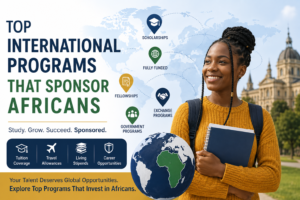
### 5. The Educational Imperative: Scholarships and Fellowships
The foundation of all economic mobility is education. However, international tuition rates and the rising cost of local tertiary education remain insurmountable barriers for millions.
**STEM and Gender Parity:** The global funding community is aggressively trying to close the gender gap in the sciences. Consequently, if you are a young African woman pursuing a degree in Science, Technology, Engineering, or Mathematics (STEM), you are highly sought after. Organizations offer massive, fully funded scholarships that cover tuition, housing, flights, and living stipends to ensure female representation in the future tech economy.
**Vocational and Technical Training (TVET):** Financial assistance is not restricted to traditional university degrees. Billions of dollars are being poured into vocational training. If a young person wants to become a master electrician, a solar panel technician, or an advanced coder, massive grants exist to cover their certification costs, ensuring they bypass the university system entirely and enter the workforce with highly lucrative, immediate skills.
### 6. Corporate Social Responsibility (CSR) and Private Foundations
Do not ignore the massive multinational corporations extracting wealth from the continent; they are legally and morally obligated to reinvest heavily into their host communities.
**The Corporate Mandate:** Major telecommunications giants, commercial banks, and international energy conglomerates operate massive CSR budgets. They frequently launch highly publicized innovation challenges, offering massive cash prizes and business incubation to young innovators.
**Strategic Alignment:** If a major bank launches a youth funding challenge, they are usually looking for fintech (financial technology) solutions. If an agricultural conglomerate launches a grant, they want agritech solutions. Tailor your applications to directly intersect with the core business operations of the corporate sponsor.
### 7. The Agritech Revolution: Funding the Future of Food
Agriculture is the absolute backbone of the African economy, employing the vast majority of the continent’s workforce. However, the sector is aging, and climate change threatens immediate disaster. To counter this, organizations are desperately trying to incentivize the youth to return to agriculture.
**Modernizing the Farm:** The funding available for young farmers and female agricultural cooperatives is staggering. However, these grants are not for traditional, subsistence farming. They are looking for “Climate-Smart Agriculture” and “Agritech.” If you are a young woman using drone technology to map crop yields, or building a mobile app that connects rural farmers directly to urban restaurants to eliminate the middleman, you have access to specialized agricultural grant pools that other industries simply do not possess.
### 8. The Digital Frontier: Funding the Tech Ecosystem
The digital economy is the ultimate equalizer. A young coder in Kigali with a stable internet connection can build software used by a corporation in Tokyo. Because tech requires very little physical infrastructure to launch, it is the darling of the funding world.
**Bootcamps and Innovation Hubs:** Massive financial assistance is available to pay for young Africans to attend rigorous coding bootcamps. Furthermore, physical innovation hubs located in major African cities are heavily subsidized by international tech giants, providing free workspace, high-speed internet, and legal mentorship to young tech founders, drastically lowering the financial barrier to entry.
### 9. The Masterclass: How to Successfully Secure the Capital
Knowing the capital exists is useless if your application is thrown into the rejection pile. You must treat the application process with the exact same rigor as a military operation.
**Step 1: Hyper-Targeted Identification**
Do not apply for a grant designed for a 40-year-old female manufacturer if you are a 22-year-old male app developer. Symmetrical alignment is everything. Read the funder’s mandate obsessively and only apply for opportunities where you are the exact demographic they are hunting for.
**Step 2: The Ruthless Eligibility Audit**
Grant officers are looking for easy reasons to reject people to thin out the thousands of applications they receive. If the guidelines state the proposal must be exactly 1,000 words in PDF format, and you submit 1,050 words in a Word Document, you are instantly disqualified. Treat the eligibility criteria as a legally binding contract.
**Step 3: Compiling the Digital Arsenal**
You cannot wait until the day before the deadline to hunt for your birth certificate. You must build a secure, cloud-based “Data Room.” This folder must contain high-resolution, certified scans of your national ID, your academic transcripts, your business registration documents, professional letters of recommendation, and a polished resume. When a portal opens, you should be able to deploy your documents within five minutes.
**Step 4: Crafting the Magnetic Narrative**
Data proves your competence, but emotion secures the check. Your personal statement or business proposal must be a gripping, cinematic narrative. Explain the severe, localized problem you are trying to solve. Explain the precise moment you realized you had to solve it. Detail exactly how their specific funding is the ultimate missing puzzle piece required for your success. Above all, focus on your impact: do not tell them how the money will make *you* rich; tell them how your success will permanently uplift your surrounding community.
**Step 5: The Follow-Up and the Interview**
If you are shortlisted, you will likely face a rigorous interview panel. Do not memorize robotic answers. Utilize the STAR method (Situation, Task, Action, Result) to structure your responses. Defend your budget with absolute financial fluency. Radiate quiet, unshakeable confidence.
### 10. The Psychology of Execution and Avoiding Fatal Pitfalls
The road to financial empowerment is heavily populated by predators. You must remain intensely vigilant against the booming scam economy.
**The Golden Rule of Scams:** Legitimate financial assistance flows in one direction: toward you. You must never, under any circumstances, pay a “processing fee,” an “administrative tax,” or an “activation charge” to receive a grant or a scholarship. If an online agent asks for your banking PIN or demands an upfront payment to guarantee your funding, it is a 100% verified scam. Protect your digital identity ruthlessly.
**The Requirement of Psychotic Persistence:** Finally, you must completely normalize rejection. You are competing against the sharpest, hungriest minds on the continent. You will receive devastating rejection emails. The individuals who ultimately secure the massive funding packages are the ones who view rejection as mere data. They ask the grant officer for specific feedback, they refine their business model, they aggressively rewrite their personal statements, and they attack the next application cycle with superior strategy.
### The Final Mandate
The financial barriers that historically paralyzed African potential are actively disintegrating. In 2026, the capital required to build your startup, acquire a world-class education, or permanently transform your community is sitting in institutional bank accounts, waiting for disciplined visionaries to claim it.
Your journey does not begin next month; it begins the moment you finish reading this sentence. Audit your current life trajectory. Define exactly how much capital you need and what specific problem you intend to solve with it. Identify three verified programs from this masterclass that align with your demographic. Gather your digital arsenal, draft your magnetic narrative, and submit your very first application. The future of the African continent belongs entirely to those bold enough to demand the resources to build it. Execute immediately.