The global narrative surrounding the African continent has undergone a profound, irreversible metamorphosis. For decades, the predominant story was one of extraction, charity, and systemic exclusion. However, as we stand firmly in the complex global economy of 2026, the paradigm has radically shifted. The world’s wealthiest nations, the most powerful philanthropic foundations, and massive multinational technology conglomerates have collectively awakened to a stark demographic reality: Africa possesses the youngest, most dynamically innovative population on the face of the planet. While Western and Asian populations are rapidly aging, Africa is overflowing with raw, brilliant, and hungry human capital.
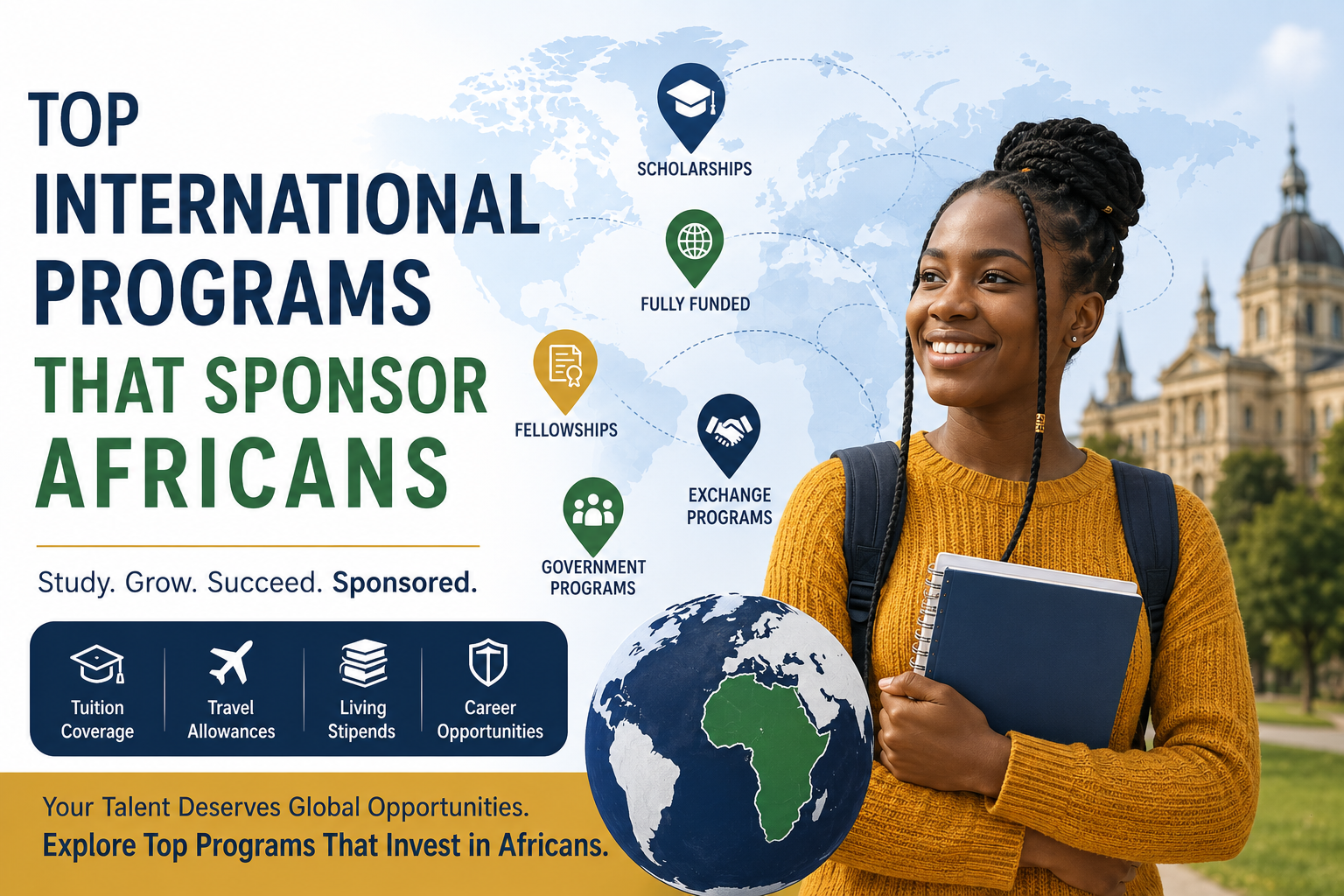
Consequently, we are currently witnessing an unprecedented “race for talent.” Global institutions are actively deploying billions of dollars in fully funded scholarships, high-level business incubators, and cross-continental fellowships designed explicitly to identify, train, and empower African visionaries. From fully financed postgraduate degrees at Oxford and Harvard to massive equity-free capital injections for tech founders in Lagos and Nairobi, the sheer volume of international capital available to Africans is staggering.
Yet, a deeply tragic paradox remains. Millions of incredibly capable students, ambitious entrepreneurs, and dedicated community leaders are entirely locked out of this global wealth transfer simply because they lack the specific institutional knowledge required to access it. They do not know where these vaults of capital are hidden, nor do they understand the complex bureaucratic languages required to unlock them. This exhaustive, multi-layered masterclass is engineered to destroy that barrier forever. We will dissect the absolute top-tier international programs actively sponsoring Africans today, explore the hidden psychology of their selection committees, and provide you with a surgical, foolproof blueprint to secure your place on the global stage.
### The Hidden Philosophy: Why the World is Funding Africa
Before you can successfully apply for a life-altering sponsorship, you must deeply understand *why* these foreign entities are willing to spend hundreds of thousands of dollars on a single African individual. This is not blind charity; it is calculated, high-level geopolitical and economic strategy.
When the British government or the European Union fully funds a Nigerian or Kenyan student’s master’s degree, they are executing “soft power” diplomacy. They want to train the future presidents, central bank governors, and corporate CEOs of the African continent within their own borders. By doing so, they foster lifelong cultural and economic allegiances. When a Silicon Valley conglomerate funds an African tech startup, they are actively building the digital infrastructure that will eventually allow them to sell their own software to the next billion internet users.
Understanding this philosophy is your ultimate advantage. When you write your application, you must stop positioning yourself as a desperate applicant begging for financial rescue. You must position yourself as a highly valuable, strategic asset—a future leader who will serve as the perfect bridge between the sponsor’s global mandate and your local African community.
—
### 1. The Mastercard Foundation Scholars Program: The Titan of Holistic Education
When analyzing educational philanthropy in Africa, the Mastercard Foundation stands as an undisputed titan. Their financial commitment to the continent is practically unparalleled, operating under a massive mandate to secure dignified, fulfilling employment for 30 million young Africans by the end of the decade.
The Scholars Program is not merely a scholarship; it is a comprehensive financial and psychological lifeline. Partnering with elite universities across the globe—from the University of California, Berkeley and the University of Edinburgh to incredible local institutions like Ashesi University in Ghana and the University of Pretoria in South Africa—the Foundation targets brilliant minds trapped in severe poverty.
A Mastercard Foundation scholarship covers absolutely everything. It pays full international tuition, provides premium housing, buys your textbooks and a high-end laptop, covers your flights, and deposits a generous living stipend into your account. More importantly, it provides rigorous leadership training, mental health support, and transition-to-work mentorship. The Foundation is obsessively searching for individuals who possess staggering intellectual capacity but have absolutely zero financial means to proceed, provided they exhibit a fierce, documented commitment to returning to their communities to execute measurable social change.
### 2. Chevening Scholarships: The British Incubator for Global Leaders
Funded directly by the United Kingdom’s Foreign, Commonwealth and Development Office (FCDO), Chevening is arguably the most prestigious government-backed scholarship available to Africans. It is specifically designed to identify mid-career professionals who possess the raw potential to become the dominant thought leaders and policymakers of their respective nations.
A Chevening award fully finances a one-year master’s degree at any accredited university within the UK. It covers your tuition, your flights, your visa fees, and your monthly rent. However, Chevening operates on a very strict diplomatic condition: upon graduation, you are legally mandated to return to your home country for a minimum of two years. You cannot use Chevening as a backdoor to immigrate to the UK. The selection committee is not simply looking for students with high grades; they are actively hunting for charismatic visionaries with highly specific, realistic 10-year career plans that detail exactly how a British education will help them solve a systemic crisis in their home country.
### 3. The Erasmus+ Programme: The Ultimate European Immersion
If your academic desires lean toward deep multicultural immersion and cross-border collaboration, the European Union’s Erasmus+ Programme is the ultimate prize. Unlike traditional scholarships that tie you to a single university campus for your entire degree, the Erasmus Mundus Joint Master Degrees mandate aggressive mobility.
Under this fully funded program, an African student is required to study in at least two (and sometimes three or four) different European countries over a two-year period. You might spend your first semester in Paris, your second in Berlin, and your third in Rome. The scholarship provides a massive monthly living allowance to facilitate this travel, completely covers your tuition, and absorbs all your European health insurance costs. Erasmus+ heavily favors applicants pursuing degrees that require diverse, global perspectives, such as renewable energy engineering, international human rights law, global public health, and sustainable urban planning.
### 4. DAAD Scholarships: Accessing the German Engineering and Policy Powerhouse
Germany has quietly established itself as one of the most attractive, high-value destinations for African scholars. A major driving factor is that the German public university system often charges zero tuition fees, even for international students. However, the cost of living in Europe remains high, which is where the German Academic Exchange Service (DAAD) intervenes.
DAAD offers a massive array of monthly stipends, research grants, and postgraduate funding specifically tailored for students from developing nations (often under their EPOS program). DAAD is incredibly generous to African students pursuing highly technical and policy-driven fields: mechanical engineering, renewable energy, public policy, environmental science, and agricultural economics. Furthermore, you do not always need to speak fluent German to win; Germany now offers hundreds of elite master’s programs taught entirely in English, making this funding highly accessible.
### 5. The Fulbright Program: America’s Premier Diplomatic Exchange
The Fulbright Program is the flagship international educational exchange program sponsored by the United States government. It carries a level of global prestige that instantly opens doors in both academia and corporate sectors worldwide.
Designed to increase mutual understanding between the people of the United States and the people of other countries, Fulbright fully funds African students to pursue master’s or Ph.D. programs at top-tier American universities. It covers your massive US tuition, international airfare, a monthly living stipend, and health insurance. Like Chevening, Fulbright operates under a J-1 visa requirement, meaning you must return to Africa for at least two years after completion to implement the knowledge you have acquired. The Fulbright committee heavily scrutinizes your “cultural ambassador” potential—they want to know how you will represent African excellence to the American public.
### 6. The Bill & Melinda Gates Foundation: Funding Deep Science and Survival
Moving away from pure educational scholarships, the Gates Foundation is the ultimate financial benefactor for Africans operating at the intersection of deep science, public health, and agricultural technology.
While they do offer the legendary, fully funded Gates Cambridge Scholarship for students attending the University of Cambridge, their impact in Africa is heavily driven by direct research grants and institutional funding. If you are a scientist, an agritech founder, or a public health NGO leader, the Gates Foundation deploys hundreds of millions of dollars to eradicate malaria, distribute vaccines, and develop drought-resistant crop varieties for African farmers. If your work deals with utilizing technology to save human lives on a massive scale, this is your primary target.
### 7. The World Bank Group: Empowering the Mid-Career Bureaucrat
The World Bank does not just lend billions to governments to build highways; they aggressively invest in the human capital required to manage those economies.
Through initiatives like the Joint Japan/World Bank Graduate Scholarship Program (JJ/WBGSP), they fully fund mid-career professionals from developing countries to pursue master’s degrees at elite universities globally. There is a catch: you must have at least three years of paid development-related work experience, and you must be pursuing a degree in a development-related topic (such as economic policy, tax administration, or infrastructure management). The World Bank wants to train the technocrats who will eventually return to Africa to stabilize its economic institutions.
### 8. The United Nations Development Programme (UNDP): Capitalizing Social Innovation
If your life’s mission is tied to the UN’s Sustainable Development Goals (SDGs)—such as eradicating extreme poverty, achieving gender equality, or fighting climate change—the UNDP is an incredible resource.
The UNDP frequently launches massive innovation challenges and youth empowerment grants across the continent (such as YouthConnekt Africa). They deploy heavy seed grants and capacity-building resources to young social entrepreneurs and civic tech founders who are building localized solutions to systemic crises. Securing UNDP funding requires a highly academic, data-driven approach; your proposal must prove exactly how your project will measurably improve human lives over a specific timeline.
### 9. Google for Startups: Accelerating the African Tech Boom
The venture capital ecosystem in Africa is exploding, and Silicon Valley is actively feeding the fire. Global technology monopolies realize that the future of the internet is African, and they are heavily subsidizing the continent’s digital infrastructure.
The Google for Startups Black Founders Fund is a wildly lucrative program. Selected African tech founders receive massive, equity-free cash awards (frequently up to $100,000). However, the hidden value is the technology subsidy. Startups often receive up to $200,000 in Google Cloud credits. For a young tech company, server and hosting costs can be financially devastating; having those costs covered for two years allows a founder to redirect all their cash into hiring elite engineers and expanding across borders.
### 10. The African Development Bank (AfDB): Financing the Macro Economy
While most founders focus on micro-grants, the African Development Bank is the institution funding the continent’s physical and economic infrastructure. Recognizing that infrastructure is useless without human capacity, the AfDB has launched aggressive youth initiatives.
Through programs like the Youth Entrepreneurship Investment Banks (YEIB), the AfDB is funneling capital into the SME (Small and Medium Enterprise) sector. They deploy massive grants, heavily subsidized credit lines, and capacity-building resources explicitly aimed at young founders operating in critical sectors like sustainable agriculture, green energy, and localized manufacturing. If you are building a capital-intensive business, the AfDB’s financial ecosystem is your ultimate target.
—
### The Execution Matrix: How to Actually Secure the Sponsorship
Knowing the names of the organizations holding the wealth is entirely useless if you do not know how to unlock their vaults. The competition for these global programs is mathematically terrifying. A single Chevening cycle might see 65,000 global applications for only 1,500 spots. You must operate with military precision.
**1. Engineering a Bulletproof, Multi-Dimensional Profile**
A flawless academic transcript (a 4.0 GPA or First Class) is fantastic, but in the realm of global sponsorships, it is merely the baseline requirement to get your file opened. Committees are rejecting straight-A students every single day because those students have zero leadership experience. You must build a verifiable track record of impact outside the classroom. Did you launch a local NGO? Did you volunteer at a public health clinic? Did you organize a tech bootcamp for girls in your village? You must prove that you are a dynamic, active participant in society, not just a passive consumer of textbooks.
**2. The Masterclass in Storytelling: The Personal Statement**
Your personal statement (or statement of purpose) is your ultimate weapon. Do not write a boring, chronological list of your achievements. Tell a gripping, cinematic story. Explain the exact “inciting incident”—the specific moment of adversity or realization—that ignited your passion for your field. Outline the massive, systemic problem in your home country you are trying to solve, and articulate exactly why their specific funding and their specific university is the missing puzzle piece you need to achieve your goals. Authenticity, vulnerability, and fierce ambition always win over robotic, corporate jargon.
**3. The Strategy of Asymmetrical Timing**
Securing international funding is a 12-to-18-month marathon. If you wait until a month before the deadline to start gathering your documents, you have already lost. You must meticulously research required standardized tests (like the IELTS, TOEFL, or GRE) and book them months in advance. You must secure your academic transcripts and give your professors ample time to write highly detailed, personalized letters of recommendation.
**4. The Law of Massive Action**
Do not fall in love with a single program. If you put all your hopes entirely on the Fulbright program and receive a rejection letter, your entire year is ruined. You must treat this process as a high-volume numbers game. Apply to Chevening, apply to DAAD, apply to five different university-specific scholarships simultaneously. By casting a massive, highly strategic net, you mathematically increase your odds of a collision with success.
**5. Executing Flawless Administrative Compliance**
The most tragic reality of this ecosystem is that over 50% of applications are disqualified before a human being ever reads them, purely due to administrative incompetence. If the portal asks for a PDF, do not upload a Word document. If the essay limit is 500 words, do not write 550 words. Check your essays for grammatical errors obsessively. You are asking highly sophisticated global organizations to hand you tens of thousands of dollars; if you cannot follow basic formatting instructions, you visually prove that you cannot be trusted to manage institutional capital.
—
### The Psychology of Rejection and Radical Persistence
The final, and perhaps most crucial, lesson you must internalize is the absolute necessity of unreasonable resilience. Rejection is the default state of the international sponsorship process. You are competing against the absolute sharpest, hungriest minds on the African continent, alongside brilliant applicants from Asia and South America. Receiving a rejection email does not mean you are unintelligent, nor does it mean your dreams are invalid; it simply means the mathematics of the competition were exceptionally tight that year.
The African students and entrepreneurs who ultimately board those international flights, who walk the halls of Oxford, and who secure the massive venture capital checks are the ones who allow rejection to refine them, not destroy them. They email the committees asking for specific feedback. They spend the next six months improving their leadership portfolios, retaking their English exams for a higher score, and ruthlessly rewriting their essays. Persistence is the ultimate equalizer in the global funding game.
### Your Immediate Mandate
The financial barriers that historically paralyzed African potential are actively disintegrating. In 2026, the capital required to acquire a world-class global education, build your startup, or permanently transform your community is sitting in institutional bank accounts across Europe, America, and Asia, waiting for disciplined visionaries to claim it.
Your journey does not begin next year; it begins the moment you finish reading this sentence. Audit your current life trajectory. Define exactly what global problem you intend to solve. Identify three verified programs from this masterclass that align perfectly with your demographic and academic goals. Gather your digital arsenal, draft your magnetic narrative, and submit your very first application. The future of the African continent belongs entirely to those bold enough to demand the resources to build it. Execute immediately.