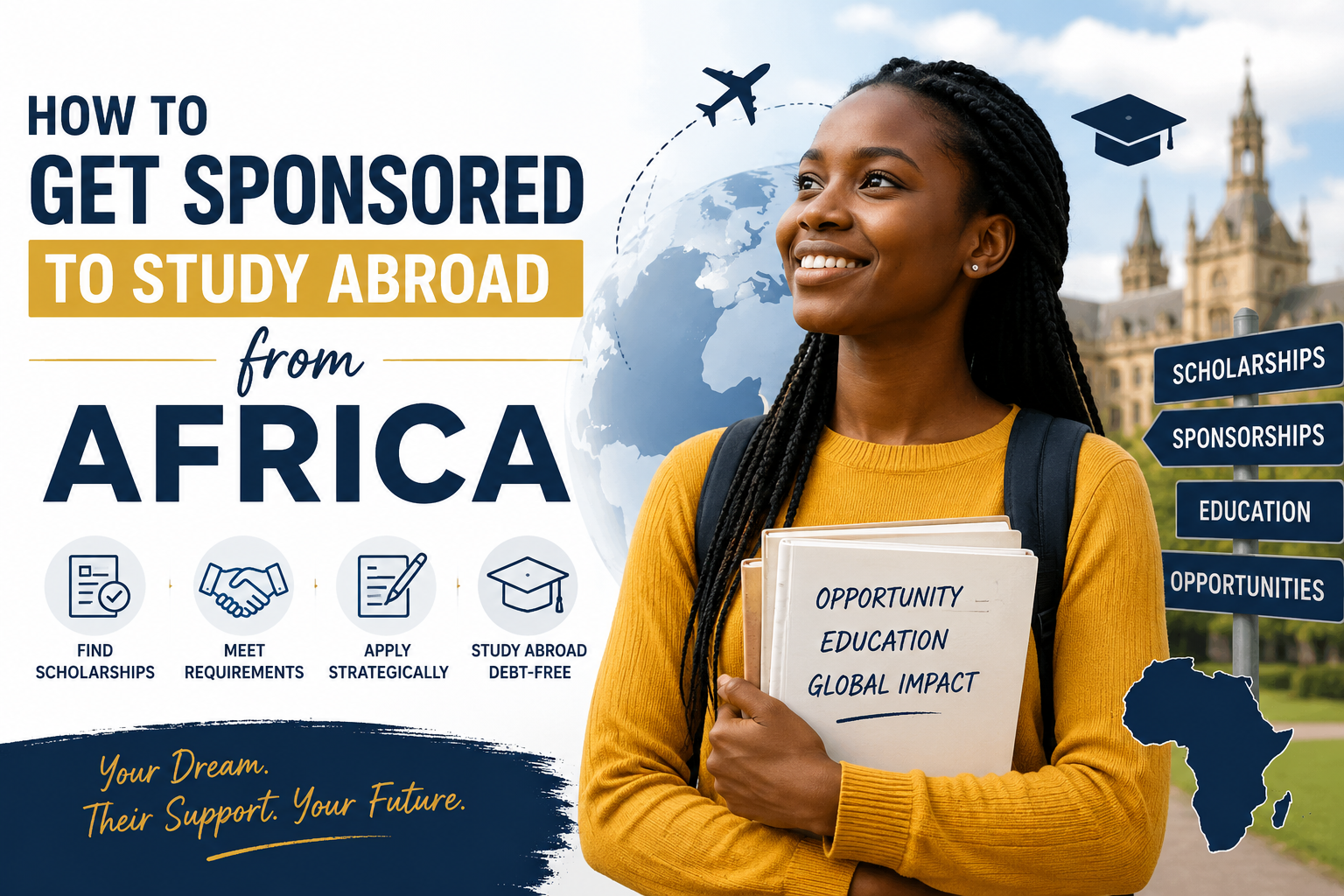
The desire to cross oceans and pursue a world-class education is one of the most powerful, transformative aspirations an individual can possess. Stepping into the lecture halls of historic, elite universities in North America, Europe, or Asia does far more than simply provide you with a beautifully printed degree. It fundamentally rewrites your cognitive architecture. It grants you access to cutting-edge research laboratories, exposes you to brilliantly diverse global perspectives, embeds you within international networks of power and influence, and ultimately positions you for high-income, globally mobile career opportunities.
However, for millions of fiercely intelligent and deeply ambitious students across the African continent, an agonizing reality persists: the primary barrier preventing them from boarding an international flight is rarely a lack of intellectual capability. It is the crushing weight of financial constraint. When international tuition fees, cross-continental flights, visa applications, and foreign living expenses are calculated in heavily depreciated local currencies, the dream of studying abroad can rapidly begin to feel like a cruel, mathematical impossibility.
Yet, as we navigate the deeply interconnected global landscape of 2026, a magnificent truth is actively unfolding. Thousands of African students are successfully relocating to foreign nations to study every single year without paying a single dime out of their own pockets. The world is currently locked in a desperate race for global talent, and wealthy nations are actively spending billions of dollars to attract the brightest African minds to their shores. The capital exists. The scholarships are heavily funded. The only difference between the student who remains financially stranded at home and the student who secures a visa is the mastery of strategy, preparation, and radical persistence.
This exhaustive, multi-layered guide will serve as your definitive blueprint, detailing exactly how to position yourself to secure massive international educational sponsorships.
### Demystifying the Anatomy of an International Sponsorship
Before you begin drafting applications, you must understand the financial vocabulary of international education. The term “sponsorship” or “scholarship” is heavily nuanced.
If you secure a “Partial Scholarship,” the institution may waive 50% of your tuition fees, leaving you to desperately scramble for funds to cover the remaining balance, your rent, and your groceries.
Conversely, the ultimate prize is the “Fully Funded Sponsorship.” This is a comprehensive financial lifeline that removes every single economic anxiety from your academic journey. A truly fully funded package covers 100% of your international tuition. Furthermore, it pays for your round-trip airfare, covers your comprehensive health insurance, reimburses your expensive visa application fees, and deposits a generous living stipend into your bank account every single month to cover your housing, food, and study materials. In simple terms, you are literally being paid a salary to acquire a world-class education.
### 1. The Global Typology of Educational Funding
To hunt effectively, you must understand exactly who is holding the money. Global funding generally falls into four highly distinct categories:
**A. Bilateral and Government-Backed Scholarships**
Wealthy nations utilize education as a supreme tool for diplomatic “soft power.” They want to train the future presidents, central bank governors, and corporate CEOs of Africa. Programs like the United Kingdom’s Chevening Scholarship, the United States’ Fulbright Program, the Australia Awards, and the Swedish Institute Scholarships are fully funded pipelines. These programs are heavily geared toward applicants who demonstrate immense leadership potential and who intend to return to their home countries to drive systemic economic or political development.
**B. Elite Institutional and University Funding**
The universities themselves are massive distributors of wealth. Top-tier global institutions operate with billions of dollars in endowments. Scholarships like the Clarendon Fund at Oxford University or the Gates Cambridge Scholarship are notoriously competitive but offer total financial freedom. Even mid-tier universities frequently offer highly competitive merit-based scholarships specifically earmarked for students from developing nations to artificially boost their campus diversity metrics.
**C. Multilateral and International Organizations**
Global powerhouses like the World Bank and various United Nations agencies heavily invest in human capital. The Joint Japan/World Bank Graduate Scholarship Program, for example, fully funds mid-career professionals from developing nations to study specific development-related topics at elite global universities.
**D. Private Philanthropic Foundations**
Private organizations endowed by billionaires are transforming global education. The Mastercard Foundation Scholars Program is the undisputed king in this arena, specifically targeting brilliant African students from economically disadvantaged backgrounds and fully funding their undergraduate or postgraduate degrees across North America and Europe.
### 2. Engineering a Bulletproof Academic Foundation
Your academic transcript is the unavoidable foundation upon which your entire application is built. Sponsorship committees receive thousands of applications from students who boast flawless 4.0 GPAs. Therefore, a perfect academic record is often just the baseline requirement to get your file opened.
However, if your grades are not absolutely flawless—perhaps you graduated with a Second Class Lower (2:2) or a Third Class—do not surrender to despair. Committees adore an upward trajectory. If you struggled during your freshman year but showed a dramatic, consistent improvement by your final year, that demonstrates resilience. Furthermore, you can significantly elevate a mediocre undergraduate GPA by accumulating three years of highly impactful, relevant work experience, or by publishing independent academic research in a recognized journal.
### 3. The Absolute Necessity of Extracurricular Leadership
This is the exact arena where the vast majority of African applicants fail. If your entire university existence consisted of attending lectures, studying in the library, and going home to sleep, you will severely struggle to secure major international funding. Sponsors are not trying to fund human calculators; they are trying to fund dynamic, disruptive future leaders.
You must build a verifiable track record of leadership outside the classroom. This does not necessarily mean you must be the president of the student union. True leadership is defined by measurable impact. Did you organize a weekend coding bootcamp for underprivileged girls in your village? Did you start a campus recycling initiative that actually reduced waste by 20%? When you apply, you must quantify this impact. The phrase “I volunteered” is weak. The phrase “I managed a team of 15 volunteers to distribute 5,000 anti-malarial nets” is a sentence that wins fully funded sponsorships.
### 4. Strategic Alignment: Choosing Your Course and Destination
Not all academic disciplines receive equal funding. If your singular goal is to secure a full sponsorship, you must understand macroeconomic global trends. The global economy in 2026 is obsessively focused on specific crises: climate change, cybersecurity, public health, artificial intelligence, and sustainable agriculture. If your chosen course of study directly addresses one of these global pain points (the STEM fields), the amount of funding available to you increases exponentially.
Additionally, your choice of destination dictates your financial strategy. While the US and the UK are the most famous destinations, they are also the most expensive. Conversely, countries like Germany, Finland, and Norway have historically offered incredibly low or entirely free tuition to international students at their public universities. When your tuition is practically zero, it becomes exponentially easier to secure a smaller, localized sponsorship just to cover your monthly rent.
### 5. Excavating the Hidden Opportunities
If you only search for “scholarships for African students” on Google, you are competing against millions of other people looking at the exact same top ten search results. You must dig deeper.
Scour the specific departmental websites of the foreign universities you want to attend; professors often have millions of dollars in unadvertised research grants and desperately need graduate assistants to help them. Utilize LinkedIn’s advanced search to find people from your home country who are currently studying abroad, and look at their profiles to see which obscure foundations funded them. Subscribe to dedicated scholarship aggregator newsletters and join highly specific Telegram or WhatsApp groups dedicated to African student mobility.
### 6. Assembling the Documentation Arsenal
International applications are heavily bureaucratic. Do not wait until a deadline is approaching to hunt for your documents. You must build a secure, cloud-based folder months in advance.
This folder must contain high-resolution scans of your international passport, your official academic transcripts (ensure they are officially stamped by your university registry), and a flawlessly formatted academic CV. Furthermore, almost all Western institutions require proof of English proficiency. You must prepare for, book, and aggressively study for standardized tests like the IELTS or the TOEFL. A poor score on these exams will instantly disqualify you, regardless of how brilliant your underlying GPA is.
### 7. The Art of the Personal Statement
Your application dossier contains your grades, but the undisputed heart of your application is your personal statement (or statement of purpose). This essay is the only time the selection committee gets to hear your actual human voice.
The most fatal mistake students make is writing a generic, emotionless essay that simply repeats their CV in paragraph form. Your personal statement must be a gripping, cinematic narrative. You must explain your “origin story.” What specific event or realization ignited your passion for your field? What colossal problem in your home country are you desperately trying to solve? How does studying at this specific university act as the magical key that unlocks your ability to solve that problem?
Avoid falling into the trap of writing a “sob story.” While it is important to acknowledge the severe obstacles you have faced in Africa, committees do not award hundreds of thousands of dollars based on pity. They award funds based on fierce resilience. Frame your challenges as the exact forge that built your unstoppable work ethic.
### 8. The Psychology of Timing and Early Strategy
Securing funding is not a process you begin a few weeks before the deadline; it is a meticulously planned, 12-to-18-month marathon. The most prestigious international sponsorships often have application deadlines that close nearly a full year before the academic program actually begins.
If you wait until you have your final university admission letter to start looking for funding, you have already lost the game. You must research scholarships simultaneously while researching universities. Create a massive master spreadsheet detailing every single grant, its eligibility requirements, the required documents, and the precise deadlines.
### 9. Auditing Your Digital Footprint
In 2026, selection committees will Google your name. If a foundation is preparing to invest $100,000 into your future, they want to ensure you will not become a public relations nightmare.
You must aggressively audit your digital footprint. Ensure your LinkedIn profile is meticulously updated, featuring a professional headshot and a detailed summary of your academic research. Scrub your Twitter or Instagram accounts of any highly inflammatory, unprofessional, or chaotic content. Your online persona must visually align with the mature, visionary leader you claim to be in your personal statement.
### 10. Dominating the Interview Stage
If you make it to the interview stage of a major sponsorship like Chevening or the Mastercard Foundation, your academic credentials have already been validated. The interview is a purely psychological test to determine if you possess the charisma, emotional maturity, and cultural adaptability to represent their brand on a global stage.
You must heavily prepare for the classic questions. Utilize the STAR method (Situation, Task, Action, Result) to answer behavioral questions, ensuring every single answer is structured as a compelling mini-story. Above all, radiate a quiet, unshakeable confidence. Do not act like a desperate beggar asking for a handout; act like a highly valuable intellectual asset offering them a brilliant global partnership.
### 11. Dodging the Fatal Application Errors
Every single year, brilliant students lose out on life-changing amounts of money due to devastatingly simple administrative errors.
Never submit an essay that contains spelling errors—it signals a terrifying lack of basic professional care. Never submit a generic essay where you accidentally forget to change the name of the university from a previous application (e.g., telling Oxford how much you love Cambridge). Follow the formatting instructions with psychotic precision; if they ask for a 500-word limit and you submit 550 words, many committees will simply throw your application in the trash without reading a single sentence.
### 12. The Underrated Power of Cold Outreach
For postgraduate students (Masters and PhDs), one of the most effective funding strategies is entirely bypassing the central scholarship committee and going directly to the source: the professors.
Identify professors at foreign universities whose research perfectly aligns with your undergraduate thesis. Send them a highly customized, polite cold email. Explain that you have read their recent publications, attach your CV, and ask if they have any available funding for Graduate Research Assistantships. If a professor wants you in their laboratory, they have the institutional power to waive your tuition and provide you with a living stipend entirely outside the standard scholarship process.
### 13. Embracing Creative Alternative Paths
If you apply for ten fully funded global sponsorships and receive ten rejections, your international journey is not over. The modern student must be financially creative.
Look into Graduate Assistantships where you teach undergraduate classes in exchange for tuition. Consider pursuing your degree in countries where the cost of living is significantly lower, such as Eastern Europe or parts of Asia. Look into remote, fully accredited online degrees from top Western universities, which carry the exact same prestige but completely eliminate the massive costs of international flights and foreign housing. Many successful African students piece together their funding like a puzzle—a partial tuition waiver from the school, a small grant from a local NGO for their flights, and a part-time campus job to cover their groceries.
### 14. The Requirement of Unreasonable Resilience
Rejection is the default state of the international sponsorship process. You are competing against the absolute sharpest minds from over fifty African nations, alongside brilliant applicants from Asia and South America. Receiving a rejection email does not mean you are unintelligent; it simply means the mathematics of the competition were exceptionally tight that year.
The students who ultimately board those planes are the ones who allow rejection to refine them, not destroy them. They ask for feedback. They spend the next six months improving their leadership portfolio, retaking their IELTS exams for a higher score, and ruthlessly rewriting their essays. Persistence is the ultimate equalizer in the funding game.
### The Final Word
Securing an international educational sponsorship is a monumental, life-altering achievement that fundamentally rewrites the trajectory of your entire family lineage. It provides you with unprecedented global exposure, elite academic training, and an international network of power players.
As a student in 2026, the digital age has democratized access to information; the funding is out there, waiting to be claimed by those bold enough to ask for it. But hope is not a strategy. You must combine your raw intelligence with meticulous planning, undeniable clarity, and relentless action.
Build your academic and leadership profile until it cannot be ignored. Apply with strategic precision. Stay fiercely consistent. And never, under any circumstances, allow a rejection letter to have the final say on your future.
**Your Immediate Action Plan:**
1. Determine exactly which global crisis your desired field of study solves.
2. Build a comprehensive spreadsheet tracking at least ten potential sponsorships applicable to your demographic.
3. Begin drafting the first outline of your personal statement tonight.
Your global journey begins the exact moment you decide to stop dreaming and start executing. Take the first step today.