There is a profound, tectonic shift occurring across the African continent right now. Historically, the narrative surrounding African capital was dominated by foreign aid, charitable donations, and debt relief. In 2026, that narrative has been entirely rewritten. We have transitioned into an era of fierce, strategic investment. The world’s largest philanthropic institutions, massive multilateral banks, and Silicon Valley technology conglomerates have realized a fundamental truth: Africa is not a continent that needs saving; it is a continent that needs capitalizing.
With the youngest, fastest-growing, and most digitally native population on the planet, Africa represents the final major frontier for global economic expansion. However, despite this massive influx of capital, a severe disconnect remains. Millions of brilliant students, visionary tech founders, and dedicated community leaders are still starved for cash. The paradox of the modern African economy is that while the funding pools have never been larger, the knowledge of how to access them remains shockingly scarce.
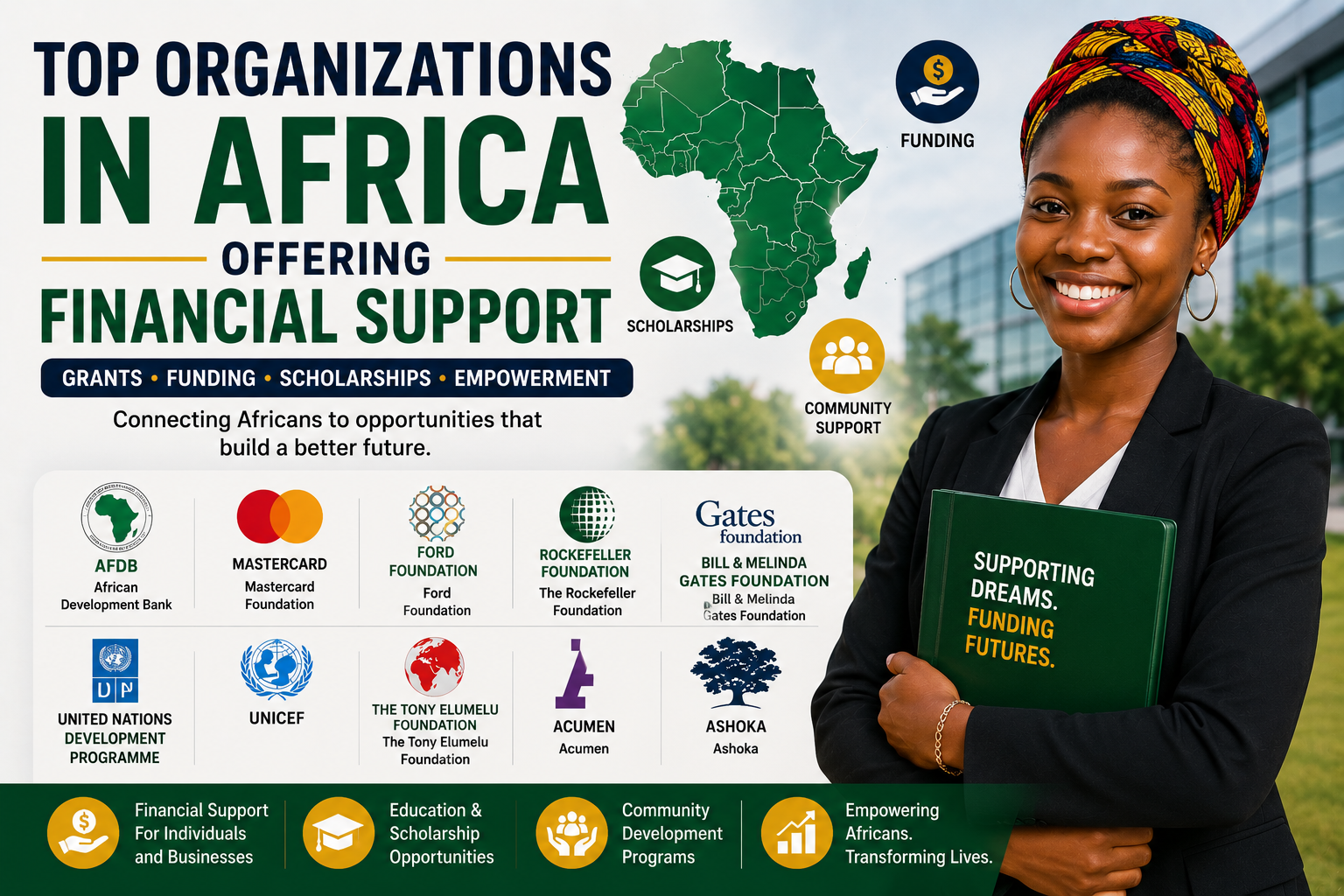
This definitive, comprehensive masterclass is designed to bridge that gap. We will forensically examine the most powerful organizations currently deploying capital across the continent. More importantly, we will dissect their underlying philosophies, what specific metrics they look for, and how you can position yourself to claim a piece of this unprecedented wealth transfer.
### The Philosophy of Institutional Capital
Before we analyze the specific benefactors, we must understand why they are releasing this capital. Financial support in the modern era is rarely an act of blind charity. These institutions operate with strict mandates. They understand that injecting capital into a local ecosystem triggers a massive multiplier effect.
When a student receives a fully funded scholarship, they do not just learn; they eventually secure high-income employment and uplift their extended family. When an agritech founder receives seed funding, they do not just build an app; they modernize the supply chain, reduce food waste, and create dozens of direct local jobs. Understanding this “multiplier effect” is crucial. When you approach these organizations, you are not asking for a favor; you are presenting yourself as the exact vessel they need to fulfill their massive global mandates.
### 1. The Tony Elumelu Foundation (TEF): The Engine of Africapitalism
If there is a single institution that has democratized entrepreneurship in Africa, it is the Tony Elumelu Foundation. Operating under the economic philosophy of “Africapitalism”—the belief that the African private sector holds the primary responsibility for the continent’s economic transformation—TEF is a legendary force.
TEF does not operate like a traditional venture capital firm that demands aggressive equity. Instead, they offer an incredibly accessible entry point. Selected entrepreneurs receive a non-refundable seed capital injection of $5,000. But the cash is only the appetizer. The true value lies in their grueling, world-class 12-week enterprise management training bootcamp. Founders are paired with veteran mentors who audit their business models ruthlessly. Upon graduation, you are inducted into the largest pan-African alumni network in existence, giving you direct access to cross-border partners from Lagos to Nairobi. TEF is strictly looking for gritty, early-stage founders with highly scalable ideas that can dominate local markets.
### 2. The Mastercard Foundation: Championing Human Capital
When it comes to educational access and youth employment, the Mastercard Foundation operates on a scale that borders on governmental. Their staggering “Young Africa Works” strategy aims to enable 30 million young Africans to secure dignified and fulfilling work by the end of the decade.
For students, their Scholars Program is the absolute gold standard of academic funding. Partnering with elite universities globally and across Africa (such as the University of Cape Town and Ashesi University), they provide incredibly comprehensive, fully funded scholarships that cover tuition, premium housing, laptops, and monthly stipends. For entrepreneurs, the Foundation frequently deploys massive block grants through local incubators to finance youth-led enterprises. They are obsessively searching for individuals who possess staggering intellectual brilliance but come from severely economically disadvantaged backgrounds.
### 3. The African Development Bank (AfDB): Financing the Macro
While most founders focus on micro-grants, the African Development Bank is the institution funding the continent’s physical and economic infrastructure. Historically known for financing multi-billion dollar highways and hydroelectric dams, the AfDB has recognized that infrastructure is useless without human capacity.
Through initiatives like the Youth Entrepreneurship Investment Banks (YEIB), the AfDB is aggressively funneling capital into the SME (Small and Medium Enterprise) sector. They deploy massive grants, heavily subsidized credit lines, and capacity-building resources explicitly aimed at young founders operating in critical sectors like sustainable agriculture, green energy, and localized manufacturing. If you are building a capital-intensive business—like a solar farm or a massive agro-processing facility—the AfDB’s financial ecosystem is your ultimate target.
### 4. The United Nations Development Programme (UNDP): The Social Impact Behemoth
If your primary objective is commercial profit, the UNDP is not for you. However, if your mission is to eradicate a deeply entrenched societal issue, the UNDP is your strongest ally. Operating in almost every African nation, the UNDP’s funding mandates are strictly tied to the UN’s Sustainable Development Goals (SDGs).
Through programs like YouthConnekt Africa, the UNDP frequently releases massive calls for proposals. They distribute heavy grants to social entrepreneurs, civic tech founders, and localized NGOs who are building solutions for climate resilience, poverty eradication, and gender equality. Securing UNDP funding requires a highly academic, data-driven approach; your proposal must prove exactly how your project will measurably improve human lives over a specific timeline.
### 5. Google for Startups: The Silicon Valley Kingmaker
The global technology monopolies know that the next billion internet users are African. To ensure those users operate on their infrastructure, companies like Google are heavily subsidizing the African tech ecosystem.
The Google for Startups Black Founders Fund is a wildly lucrative program. Selected tech founders receive massive, equity-free cash awards (frequently up to $100,000). However, the hidden value is the technology subsidy. Startups often receive up to $200,000 in Google Cloud credits. For a young tech company, server and hosting costs can be financially devastating; having those costs covered for two years allows a founder to redirect all their cash into hiring elite engineers. If you are building a highly scalable, software-driven business, corporate tech grants are unparalleled.
### 6. The Ford Foundation: Engineering Social Justice
The Ford Foundation operates differently from corporate tech funds. They are deeply entrenched in the fight against systemic inequality. They recognize that economic growth in Africa is meaningless if it only benefits the top 1%.
The Ford Foundation deploys hundreds of millions of dollars in grants to organizations fighting for human rights, civic engagement, and economic inclusion. If you are leading an advocacy group, running a legal clinic for marginalized communities, or producing documentary films that highlight societal injustices, the Ford Foundation represents a massive pool of patient, mission-driven capital.
### 7. The Bill & Melinda Gates Foundation: The Science of Survival
Arguably the most famous philanthropic entity on earth, the Gates Foundation is highly specialized. They do not fund generic e-commerce apps or real estate ventures. They are aggressively focused on utilizing science and technology to eradicate disease and extreme poverty.
In Africa, their capital is heavily concentrated in two sectors: Public Health and Agriculture. They provide staggering grants for clinical research, vaccine distribution logistics, and biotechnology startups working on malaria or HIV eradication. Simultaneously, they heavily fund agritech innovators developing drought-resistant crops or mobile supply-chain platforms for rural farmers. If your startup operates at the intersection of deep science and human survival, this is your ultimate benefactor.
### 8. The African Women’s Development Fund (AWDF): Shattering the Patriarchy
Venture capital statistics globally, and particularly in Africa, show a horrifying gender bias. Female founders receive a fraction of a percent of total deployed capital. The AWDF was built explicitly to destroy this imbalance.
Operating entirely as a grant-making foundation, they deploy critical capital directly into the hands of women-led organizations, female entrepreneurs, and activists. They finance projects focusing on female economic empowerment, reproductive health rights, and political leadership training. The AWDF is one of the most critical safety nets and accelerators for the African female visionary.
### 9. Omidyar Network: Investing in Civic Tech
Founded by the creator of eBay, the Omidyar Network bridges the gap between pure philanthropy and venture capital. They identify as a “philanthropic investment firm.”
In Africa, they are highly focused on digital identity, property rights, and civic technology. They support founders who are building platforms that increase government transparency, provide digital IDs to the unbanked, or utilize blockchain to secure land registries. They offer a unique hybrid of funding, deploying both traditional equity-free grants and aggressive venture capital investments depending on the commercial viability of your startup.
### 10. Shell LiveWIRE: Fueling Sustainable Energy Transition
As the global narrative shifts away from fossil fuels, legacy energy companies are aggressively investing in the green transition. Shell LiveWIRE is a massive enterprise development program operating heavily in nations like Nigeria and South Africa.
They provide seed funding, rigorous business incubation, and access to global supply chains for young entrepreneurs building solutions in renewable energy, circular economies, and sustainable logistics. If your startup focuses on solar tech, waste-to-energy conversion, or eco-friendly manufacturing, corporate energy programs offer deep pockets and massive industrial networks.
### 11. The African Union (AU): Policy-Backed Capital
The African Union does not just draft policy; it actively funds its execution. Driven by their “Agenda 2063” mandate, the AU frequently launches continental innovation challenges and research grants.
These programs are unique because they highly favor cross-border collaboration. The AU will often provide massive grants to a consortium of researchers or founders operating across three or four different African countries. Their goal is to foster a unified, borderless African economic bloc, and they actively finance the young leaders building the infrastructure for it.
### 12. The Hidden Gems: Grassroots and Local NGOs
It is incredibly easy to become obsessed with the massive global names and ignore the local ecosystem. National corporate foundations, faith-based organizations, and highly localized municipal NGOs control massive amounts of capital.
While a global fund like the Gates Foundation might offer a $500,000 grant, you are competing against 10,000 applicants globally. A local municipal NGO might only offer a $2,000 grant, but you are only competing against five people in your immediate neighborhood. For an early-stage founder, securing a small local grant provides the exact prototype funding required to eventually win the massive global awards.
### The Master Strategy: How to Actually Secure the Capital
Knowing the names of the banks is useless if you do not know how to unlock the vault. The competition for these funds is mathematically staggering. You must operate with military precision.
**1. The Sniper Approach vs The Shotgun Approach**
Do not send the exact same generic application to the Ford Foundation and Google for Startups. They have fundamentally different DNA. A tech incubator wants to see your user acquisition costs and scalability. A social justice foundation wants to see your community impact metrics and your theory of change. You must hyper-target your proposal, altering the language, the metrics, and the narrative to perfectly match the specific mandate of the organization you are pitching.
**2. The Architecture of a Winning Proposal**
Vague idealism is the enemy of funding. Do not say, “I want to improve education in my country.” Say, “I require $12,500 to deploy a localized, offline e-learning software to 400 rural students in the Kano state, which historical data proves will increase regional literacy rates by 18% within nine months.” Be absolutely forensic with your budgeting. Investors need to see exactly where every single dollar is going.
**3. The Narrative Arc**
Data secures the intellect, but stories secure the check. Behind every spreadsheet must be a compelling human narrative. Why are you the specific founder destined to solve this problem? What personal adversity did you overcome that gives you a unique insight into this market? Funders invest in the resilience of the human being long before they invest in the business plan.
### Dodging the Fatal Errors
The most tragic reality of this ecosystem is that over 60% of applications are disqualified before a human being ever reads them, purely due to administrative incompetence.
Never submit an application at 11:59 PM on the day of the deadline; servers will inevitably crash. Never submit a document in a Word format if the portal specifically requested a PDF. Never ignore the word count limits. You are attempting to convince highly sophisticated organizations to hand you tens of thousands of dollars. If you cannot follow basic formatting instructions, you visually prove that you cannot be trusted to manage institutional capital.
### The Final Mandate
The continent is currently experiencing a golden age of financial liquidity. The organizations listed above hold the keys to generational wealth, massive societal impact, and elite global education. The capital is waiting in their treasuries, actively looking for ambitious, disciplined Africans to claim it.
Your journey does not begin tomorrow. It begins tonight. Audit your current goals. Select three organizations from this masterclass whose specific mandates perfectly align with your vision. Scour their official websites for their upcoming funding cycles. Download their previous application guidelines, build a digital folder for your required documents, and begin drafting your narrative. The financial barriers to your success have been officially removed; your only remaining obstacle is your willingness to execute.