The African creative and entrepreneurial ecosystem has reached a boiling point of hyper-competition. As we navigate the complexities of 2026, the era of securing a corporate sponsorship simply by knowing a brand manager’s cousin is officially dead. Whether you are a rising digital influencer in Lagos, a tech summit organizer in Nairobi, an independent filmmaker in Johannesburg, or a student union leader in Accra, you are all fiercely fighting for a slice of the exact same corporate marketing budgets.
Multinational brands, telecommunications giants, and wealthy angel investors are actively deploying billions of dollars across the continent. However, they are ruthlessly analytical about where that money goes. They are no longer captivated by mere “good ideas.” They demand undeniable commercial value, crystal-clear return on investment (ROI), and staggering professionalism.
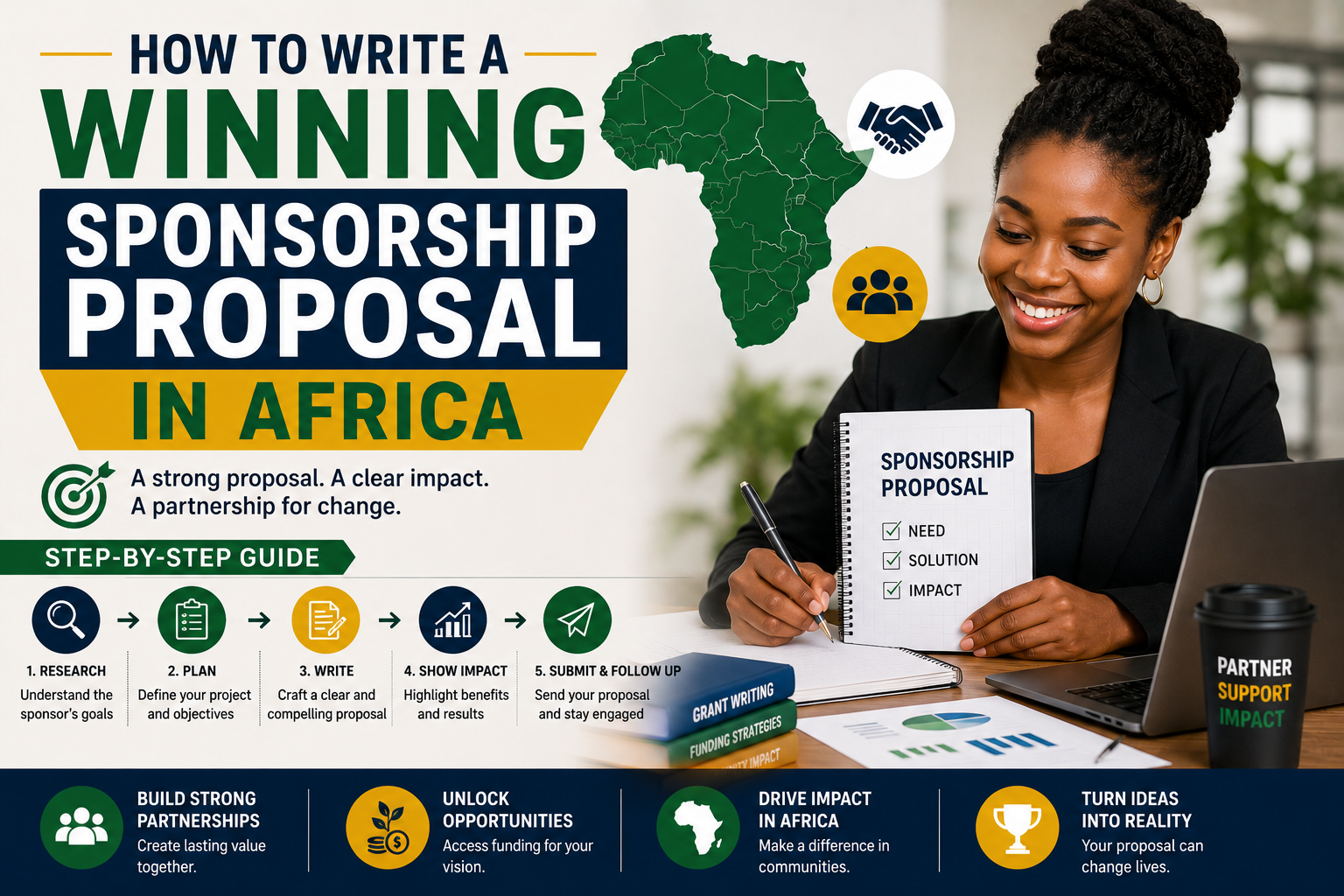
The vehicle that bridges the gap between your brilliant idea and their deep pockets is the sponsorship proposal. A masterfully crafted proposal is not just a document; it is a psychological weapon. It is the definitive difference between securing a multi-million-naira funding deal and being permanently ignored. This exhaustive guide will deconstruct the anatomy of a winning sponsorship proposal, providing you with the exact psychological triggers and structural blueprints needed to secure corporate capital in modern Africa.
### The True Philosophy of a Sponsorship Document
Before writing a single sentence, you must undergo a violent paradigm shift regarding what a sponsorship actually is. A fatal mistake made by countless African creatives is treating a sponsorship proposal like a begging letter or a charitable grant application.
A sponsorship is not a donation. It is a calculated, high-stakes Business-to-Business (B2B) transaction. You have captured the attention of a specific, highly valuable demographic; the corporation has a product they desperately need to sell to that demographic. Your proposal is simply a legally binding contract offering to rent them your audience’s trust for a specified fee. If your document does not explicitly scream, “Here is exactly how investing in me will make you more money or elevate your brand prestige,” it belongs in the trash.
### Step 1: Executing Ruthless Corporate Reconnaissance
Never send a blind pitch. Before you even open a blank document, you must become intimately obsessed with the specific brand you are targeting.
If you are pitching a massive telecom company, you must know what their current quarterly marketing campaign is. Are they pushing a new 5G data plan targeting university students? If so, your proposal must explicitly position your project as the ultimate vehicle to sell those 5G plans. Research their past sponsorships. If a bank exclusively sponsors classical jazz festivals and luxury art galas, pitching them a chaotic, underground street-wear convention is a profound waste of time. Your proposal must mirror the brand’s exact corporate values, color psychology, and demographic targets.
### Step 2: The Executive Hook (The Introduction)
Corporate marketing directors are arguably the busiest people in the commercial sector. They receive dozens of PDFs every single week. You have approximately ten seconds to convince them not to close your document.
Your introduction must be an aggressive, highly polished “elevator pitch.” Do not waste space with a long, poetic autobiography. State exactly who you are, what your platform is, and the sheer scale of your influence.
*Weak Example:* “Hello, my name is John. I love making videos about technology and I hope you can support my dream of hosting a tech event.”
*Masterclass Example:* “I am an Abuja-based consumer technology analyst commanding an actively engaged audience of 150,000 Gen-Z professionals across YouTube and X. My content specifically drives software adoption and hardware sales within the West African tech ecosystem.”
### Step 3: The Project Architecture
Once you have hooked the reader, you must instantly ground the proposal in physical reality. Corporate executives hate vagueness; it signals amateurism. You must clearly and methodically break down the exact logistics of the entity they are sponsoring.
If it is a physical event, explicitly state the official name, the confirmed dates, the venue capacity, and the projected foot traffic. If it is a digital content series, state the number of episodes, the publishing schedule, and the platform distribution strategy. Leave zero room for imagination regarding the structural mechanics of your project.
### Step 4: The Financial Justification (The ‘Why’)
This section is where many brilliant African visionaries completely sabotage their chances. You must transparently articulate exactly why you are asking for capital and precisely where those funds will be deployed.
Do not simply state, “I need $10,000 to make this happen.” Break the budget down into highly professional macro-categories. Show them that 40% of the capital is allocated for premium audiovisual production, 30% is allocated for aggressive digital marketing, 20% for venue logistics, and 10% for administrative overhead. By providing a transparent financial blueprint, you instantly telegraph to the sponsor that you are a highly organized, trustworthy custodian of their corporate capital.
### Step 5: The Commercial ROI (What’s In It For Them)
This is the undisputed heart of your entire proposal. If you fail this section, nothing else matters. You must brutally translate your project into commercial benefits for the sponsor.
Brands sponsor projects for three primary reasons:
1. **Direct Sales & Lead Generation:** They want to sell their product directly at your event or via your promo codes.
2. **Brand Equity & Visibility:** They want their logo plastered across your highly viewed media assets to maintain top-of-mind awareness.
3. **Audience Harvesting:** They want access to the email lists and data of the people attending your event.
You must explicitly list the benefits. Will their logo be on the step-and-repeat banner? Will they receive five minutes of uninterrupted stage time to pitch to the crowd? Will you produce three dedicated, high-budget TikTok videos exclusively reviewing their product? Make the value overwhelmingly obvious.
### Step 6: Data-Driven Audience Demographics
In 2026, data is the only currency that matters. A marketing executive cannot justify a sponsorship check to their CEO based on “good vibes.” They need hard, verifiable mathematics.
Do not just say, “I have a lot of followers.” You must provide a granular, surgical breakdown of the audience you control.
* **Location:** Are 70% of your followers based in Nairobi, or are they scattered globally?
* **Age Bracket:** Are you targeting teenagers with no disposable income, or 25-to-35-year-old professionals with massive purchasing power?
* **Engagement Rate:** A creator with 10,000 followers and a 12% engagement rate is infinitely more valuable than a creator with 100,000 followers and a 0.5% engagement rate.
Provide screenshots from your social media analytics dashboards. Prove to the brand that your audience matches their target consumer profile perfectly.
### Step 7: The Activation and Amplification Strategy
A logo on a flyer is a lazy sponsorship. Modern African brands want “Activations”—meaning they want to know exactly how their brand will live and breathe within your project.
If a beverage company sponsors your music festival, do not just put their logo on the ticket. Propose a “Custom VIP Lounge” fully branded in their colors, where attendees can take Instagram-worthy photos holding their drink. If a bank sponsors your podcast, propose a dedicated segment every episode where you answer fan questions regarding financial literacy, brought to them by the bank. Show the brand that you are actively strategizing ways to deeply integrate their product into the cultural fabric of your project.
### Step 8: Social Proof and Historical Case Studies
The primary psychological emotion of any corporate investor is risk aversion. They are terrified of giving money to an amateur who will ruin their brand reputation. Your job is to aggressively mitigate that risk by providing social proof.
If you have executed previous events or content series, you must include a “Case Study” slide. Show high-resolution photos of packed crowds from last year’s event. Highlight a previous brand you worked with and show the exact metrics you generated for them (e.g., “Our 2025 campaign drove 4,500 unique link clicks to the sponsor’s landing page”). If this is your very first project, include testimonials or letters of endorsement from respected figures in your industry to borrow their credibility.
### Step 9: The Psychology of Tiered Packaging
Never present a brand with a single, massive price tag. If you ask for $20,000 and their budget is only $5,000, they will simply say no and walk away. You must utilize the psychological pricing strategy of tiered packaging.
Create three distinct levels of entry:
* **The Platinum/Title Sponsor (e.g., $15,000):** This is the ultimate tier. The event is named after them (e.g., “The [Brand Name] Tech Summit”). They get maximum logo visibility, exclusive stage time, and massive digital integration.
* **The Gold Sponsor (e.g., $7,000):** A middle-tier option offering strong logo placement on digital flyers, mention in all press releases, and a physical vendor booth at the event.
* **The Silver/Support Sponsor (e.g., $2,500):** A low-risk entry point for smaller brands, offering basic social media shoutouts and logo placement on the website.
By providing tiers, you shift the executive’s psychological question from “Should we sponsor this?” to “Which package should we choose?”
### Step 10: Elite Visual Aesthetics
Human beings are intensely visual creatures. If your proposal is a massive, unbroken wall of 12-point Times New Roman text on a stark white Microsoft Word document, you will look like an amateur.
Your proposal must be a gorgeously designed, highly visual PDF deck (usually horizontal, designed in a 16:9 ratio like a PowerPoint). Utilize design software like Canva or Figma. Keep the fonts clean, modern, and easily readable. Incorporate high-quality, professional photography. Use plenty of “white space” so the document breathes. A visually stunning document subliminally communicates that you possess premium taste and execution skills.
### Step 11: The Decisive Call to Action
Do not end your proposal abruptly. The final page must serve as a highly professional call to action, explicitly instructing the reader on the exact next steps.
Include your direct phone number, your professional email address, and links to your primary digital platforms. End with a confident closing statement: *”We are highly confident that this partnership will drive immense commercial value for [Brand Name]. I will follow up via email on Tuesday to schedule a brief 15-minute alignment call.”*
### Step 12: The Ruthless Art of the Follow-Up
The reality of corporate Africa is that emails get buried. If you send a proposal and simply sit by the phone waiting, you will starve. The fortune is entirely in the follow-up.
Wait exactly five to seven business days after your initial email. Send a highly polite, concise follow-up message: *”Hi [Name], bringing this to the top of your inbox. I know Q3 is incredibly busy for your team, but I wanted to ensure you received the partnership deck. Let me know if you have five minutes this week to discuss.”* Persistence demonstrates absolute belief in your project.
### Fatal Pitfalls to Avoid at All Costs
Even a brilliant proposal can be instantly destroyed by amateur mistakes. Guard against these fatal errors:
* **The Copy-Paste Disaster:** Sending a proposal to Coca-Cola that still accidentally has the Pepsi logo on page four because you forgot to change the template.
* **Grammatical Carnage:** Spelling errors signal a terrifying lack of attention to detail. If you cannot spellcheck a document, a brand will not trust you with millions of naira.
* **The “Me” Syndrome:** Using the words “I” and “Me” fifty times, and the word “You” (referring to the brand) only twice. The proposal is about them, not you.
### The Final Word
Drafting a magnetic sponsorship proposal is not an innate talent; it is an acquired, highly lucrative skill. It demands a hybrid of creative storytelling, aggressive sales psychology, and ruthless corporate strategy.
The African ecosystem is currently flush with brands desperately looking for authentic, culturally relevant platforms to help them sell their products. You possess the cultural relevance; you simply need to package it into a language that corporate executives understand.
Your action plan begins today. Stop operating informally. Take your best, most ambitious project idea. Open a blank presentation canvas, meticulously follow the twelve steps outlined in this masterclass, and build your digital pitch deck. Identify three highly aligned brands, find the LinkedIn profile of their Marketing Directors, and send the email. The capital is waiting for you; you just have to be professional enough to claim it.