Across the African continent, an unprecedented entrepreneurial renaissance is currently unfolding. We are witnessing a brilliant new generation of founders aggressively building high-growth tech startups, launching lucrative e-commerce platforms, and designing innovative solutions to systemic local problems. However, while raw ambition and brilliant ideas are incredibly abundant from Lagos to Nairobi, the financial capital required to scale these ideas remains a severe bottleneck.
The exhilarating truth of the 2026 economy, however, is that corporate sponsors, angel investors, multinational NGOs, and government funds are actively hunting for young African talent to back. They are desperate to align their massive brands with high-impact, culturally relevant, and rapidly growing local businesses. The central question is not whether the corporate capital exists; the question is entirely about how you strategically position yourself to become an undeniable magnet for that capital.
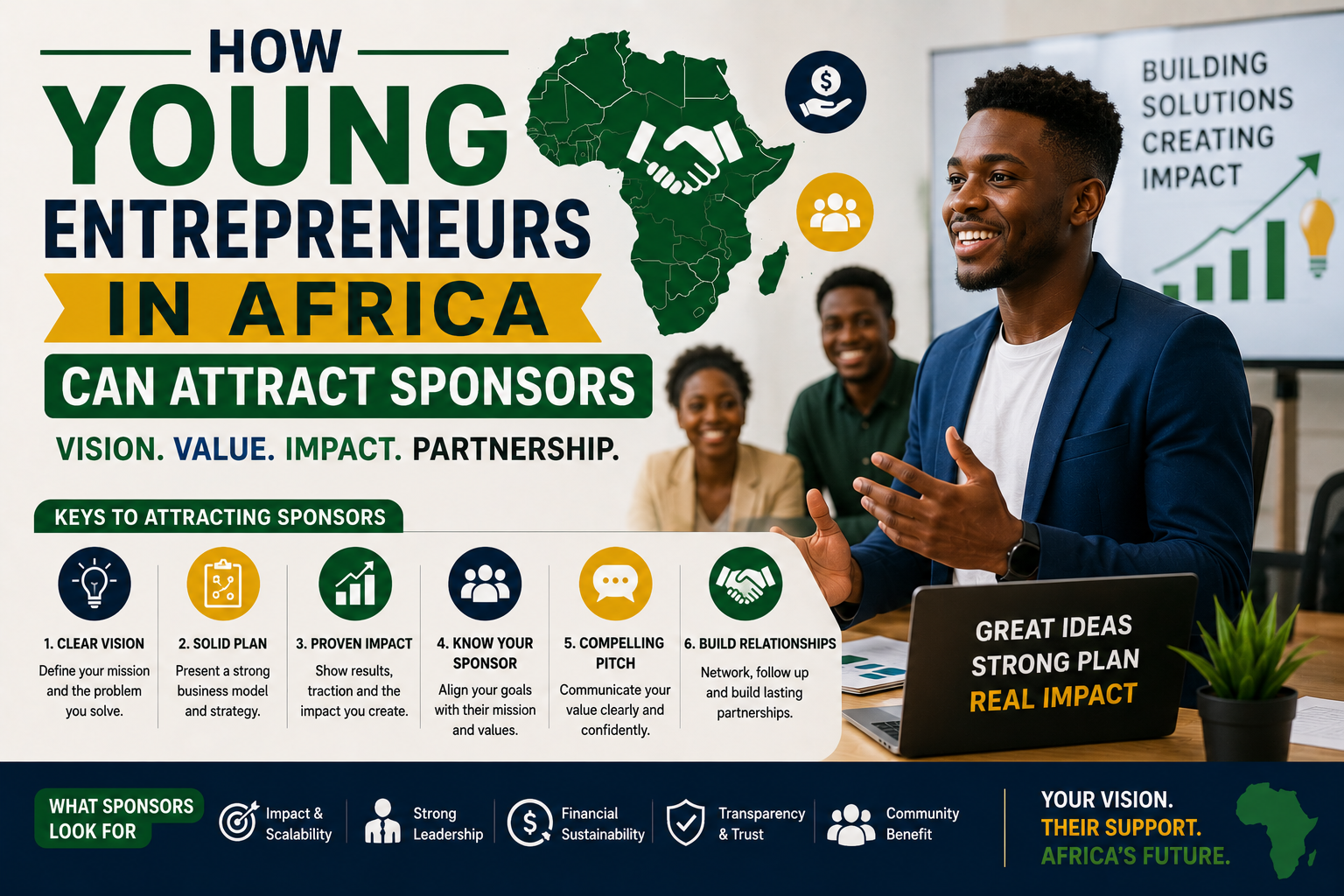
This comprehensive masterclass will dismantle the exact mechanics of corporate attraction, detailing exactly how young African entrepreneurs can secure high-level sponsorships in a fiercely competitive modern market.
### The Fundamental Philosophy of Corporate Attraction
Before sending a single email, you must destroy the toxic mindset that sponsorship is a form of corporate charity. A sponsor is not a donor giving you a handout because they pity your struggle. A sponsorship is a calculated, high-stakes Business-to-Business (B2B) commercial partnership.
When a multinational corporation or a wealthy investor provides you with financial capital, marketing exposure, or physical resources, they expect a massive return on their investment (ROI). They are essentially renting the trust and attention you have built with your community to sell their own products, elevate their brand prestige, or fulfill their corporate social responsibility mandates. If your pitch does not explicitly scream commercial value, it will be immediately discarded.
### 1. Cultivating a Laser-Focused Commercial Vision
Corporate sponsors are highly attracted to absolute clarity. If you cannot explain your business model in two simple sentences, a marketing director will not trust you with their budget. You must possess a granular understanding of the specific societal or market problem you are solving. A scattered, vague business model signals amateurism. A hyper-focused solution—such as “We provide affordable cold-storage logistics for rural tomato farmers in Kenya”—is a narrative that a sponsor can easily understand and confidently fund.
### 2. Monetizing Your Audience Demographics
Sponsors do not invest in products; they invest in access to audiences. You must transition from guessing who your customers are to possessing hard, empirical data. Simply stating, “I target young Africans,” is completely useless. You must be able to confidently declare, “I command an audience of 25,000 Nigerian university students, aged 18 to 24, who are highly interested in personal finance and mobile gaming.” The more surgically precise your demographic data is, the more attractive your platform becomes to a brand trying to reach that exact demographic.
### 3. Engineering a Premium Corporate Identity
Your brand is your visual handshake. In 2026, there is zero excuse for terrible aesthetics. A corporate sponsor wants to ensure that aligning their multi-million dollar logo next to yours will not damage their reputation. Invest the necessary time to build a cohesive visual identity. Utilize a clean, professional logo, maintain a consistent color palette across all your digital assets, and ensure your messaging is sharp and articulate. Sponsors heavily favor young founders who look and operate like established veterans.
### 4. The Undeniable Gravity of Traction
Ideas are cheap; execution is the only currency that matters. Sponsors want to fund a moving train, not an empty station. You must provide undeniable proof of traction before asking for a massive check. Traction is mathematical evidence that the market actually wants what you are building. It can manifest as $500 in early revenue, 1,000 active beta testers on your app, or a highly engaged email newsletter list. Even microscopic progress drastically reduces the sponsor’s psychological risk.
### 5. Designing an Elite Pitch Deck
Your pitch deck is your ultimate commercial weapon. It is a highly visual, concisely written document that tells the story of your business in under twelve slides. A world-class deck must aggressively highlight the market problem, your unique solution, the total addressable market size, your underlying business model, the current traction you have achieved, and exactly what the sponsor will receive in return for their capital. Keep it fiercely data-driven and visually breathtaking.
### 6. Expanding Your Digital Footprint
If a corporate executive cannot find a highly professional trace of your existence on Google, they will assume you do not exist. In the modern era, visibility is equivalent to credibility. You must aggressively document your entrepreneurial journey online. Utilize platforms like LinkedIn to share your business insights, TikTok to show the behind-the-scenes reality of building your product, and YouTube to educate your consumers. Countless massive sponsorships are initiated simply because an executive saw a brilliant, viral post from a young founder.
### 7. The Art of Strategic Symmetrical Alignment
A fatal error made by young founders is pitching to every single brand they can find. You must hunt for symmetrical alignment. If you run a sustainable fashion brand in Accra, do not waste your time pitching a heavy machinery corporation in South Africa. Look for massive retail banks running youth enterprise campaigns, or international textile NGOs. Pitching a highly relevant sponsor drastically increases your conversion rate because their corporate goals naturally align with your business operations.
### 8. The Architecture of the Value Exchange
When you finally draft the proposal document, you must obsessively focus on the ROI for the sponsor. Stop talking about why you need the money, and start talking about what they will gain by giving it to you. Will they receive exclusive naming rights to your upcoming product launch? Will their logo be deeply integrated into a viral marketing campaign? Will you grant them access to survey your massive customer base? Frame the entire partnership around their corporate victory.
### 9. The Psychology of the Micro-Sponsorship
Ego has killed countless businesses. Do not demand a $50,000 check for your very first project. You must prove you can manage capital responsibly. Start by targeting local businesses, regional politicians, or mid-sized community organizations for smaller sponsorships of $500 or $1,000. Executing these micro-sponsorships flawlessly provides you with the verified case studies and the concrete social proof required to eventually close the massive, multi-national deals.
### 10. Leveraging Experiential Activations
Sponsors absolutely love physical events because they offer immediate, tangible visibility. If your digital business can host a physical touchpoint—such as a specialized masterclass, a community hackathon, or a high-end networking dinner—you instantly create highly sponsor-able inventory. Brands will happily pay to set up a physical booth or provide branded merchandise at an event where their target consumers are physically gathered.
### 11. Avoiding the Fatal Pitfalls of the Pitch
The road to corporate funding is littered with entirely avoidable mistakes. Never send a blind email asking for cash without offering a commercial exchange. Never submit a proposal riddled with grammatical errors, as it signals a terrifying lack of operational competence. Never overestimate your audience size; if a brand demands the analytics data and catches you lying, your reputation in the industry is permanently destroyed.
### 12. The Requirement of Psychotic Persistence
Securing a corporate sponsor is a brutal numbers game. You will face an astonishing amount of rejection. You might send out forty brilliant proposals and receive thirty-nine devastating “No”s. The founders who ultimately secure the massive checks are the ones who do not take rejection personally. They wait five days, send a highly professional follow-up email to keep the conversation alive, ask for constructive feedback, refine their pitch deck, and attack the next target with unshakeable confidence.
### Your Immediate Mandate
The African economic landscape is currently overflowing with corporate capital desperately looking for visionary young founders to champion. The opportunity is undeniable, but the execution is entirely up to you.
Your mandate begins right now. Audit your business model and clarify exactly what problem you solve. Build a stunning twelve-slide pitch deck detailing your traction and audience demographics. Identify just three corporate brands whose values perfectly align with your mission, find their marketing directors on LinkedIn, and send a highly customized pitch. The capital you require to change the continent is waiting; you simply have to be strategic enough to go and claim it.