Across the African continent, a profound transformation is occurring in how systemic problems are solved. The era of waiting passively for top-down government intervention has largely been replaced by a fierce, localized movement of social entrepreneurs, community organizers, and grassroots visionaries. These individuals are actively building solutions to combat climate change, eradicate educational inequality, empower marginalized genders, and revolutionize rural healthcare. However, while the passion and the localized expertise are incredibly abundant, the financial capital required to scale these interventions remains a monumental hurdle.
This is exactly where Non-Governmental Organizations (NGOs) and international philanthropic foundations step in. NGO funding is arguably the most vital financial lifeline operating in the African development sector today. These institutions possess billions of dollars in capital, and their singular mandate is to deploy that money into the hands of local leaders who can execute measurable social change.
If you are a founder with a brilliant social impact project, the capital exists. The challenge is not a lack of money; the challenge is mastering the highly competitive, deeply analytical process of grant acquisition. This exhaustive guide will deconstruct the exact mechanics of how to attract, apply for, and successfully secure NGO funding in Africa.
### Decoding the Nature of Philanthropic Capital
Before drafting a single proposal, you must understand the psychology of an NGO. Unlike commercial venture capitalists who demand financial returns and equity, NGOs demand “impact returns.” When they deploy capital, it typically manifests in several distinct formats:
* **Direct Grants:** Non-repayable cash injections to execute a specific project within a specific timeframe.
* **Capacity Building:** Funding dedicated solely to training your staff, upgrading your software, or improving your organizational governance.
* **Resource Allocation:** Supplying you with physical assets—such as solar panels, medical equipment, or agricultural machinery—rather than liquid cash.
Your project must be designed to generate an undeniable public good. If your primary goal is to maximize your own personal wealth, you belong in the venture capital sector. If your primary goal is to structurally improve human lives, you belong in the NGO ecosystem.
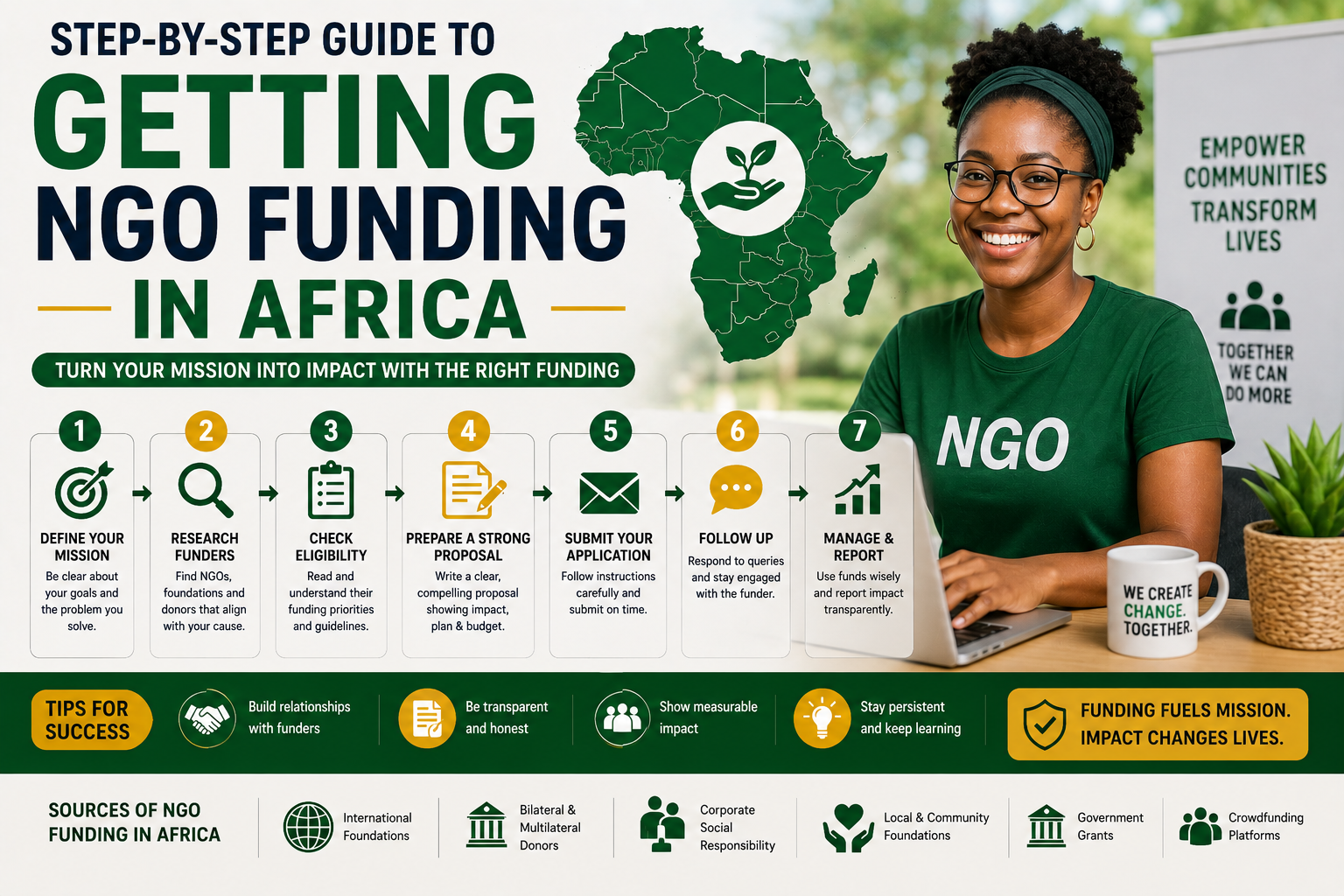
### Step 1: Hyper-Targeted Institutional Prospecting
The most common, fatal mistake applicants make is utilizing a “shotgun approach”—sending the exact same generic proposal to fifty different organizations. Every single foundation has a fiercely protected, highly specific mandate.
You must identify the institutions whose DNA perfectly matches your project.
* If you are building a scalable, tech-driven solution to eradicate rural poverty, the **United Nations Development Programme (UNDP)** is a prime target.
* If you are fighting for human rights, civic engagement, or educational equity, the **Ford Foundation** is heavily capitalized in this space.
* If your intervention relies on deep science—such as biotechnology for crop resilience or vaccine distribution—the **Bill & Melinda Gates Foundation** is your ultimate benefactor.
* If you are leading an initiative explicitly designed to dismantle patriarchal systems and empower female leadership, the **African Women’s Development Fund (AWDF)** is specifically engineered for you.
Never attempt to force your project to fit an NGO’s mandate. This is called “mission drift,” and grant officers can spot it instantly.
### Step 2: Analyzing the Funder’s Strategic Priorities
Once you have identified a potential donor, you must become intimately obsessed with their current strategic goals. Do not just look at what they funded five years ago; look at what they are funding *this year*.
Read their annual reports. Are they currently pivoting their focus toward climate resilience in East Africa? Are they hyper-focused on youth unemployment in West Africa? If your project addresses sanitation in rural schools, but the NGO explicitly states their 2026 budget is entirely dedicated to urban tech education, your application will be immediately rejected regardless of how brilliant your idea is.
### Step 3: Architecting a Surgical Intervention
NGOs do not fund vague altruism; they fund surgical interventions. You must transition from possessing a broad desire to “help people” to possessing a highly structured “Theory of Change.”
Do not tell a grant officer, *”I want to empower women in my community.”* That is a sentiment, not a strategy. You must state, *”I require funding to establish a six-month intensive coding bootcamp for 50 unemployed single mothers in Nairobi, which will culminate in guaranteed remote internships, permanently elevating them above the poverty line.”* Clarity is the ultimate currency in the funding world.
### Step 4: Crafting the Master Proposal
Your written proposal is your singular opportunity to convince a skeptic to hand you thousands of dollars. It must be a masterpiece of logic and persuasion. A world-class proposal strictly adheres to this architecture:
1. **The Executive Summary:** A brilliant, one-page distillation of the entire document. Most grant officers decide whether to reject you based purely on this single page.
2. **The Needs Assessment (The Problem):** Utilize hard, localized data to prove why this problem is a crisis. Do not use global statistics; use local community data.
3. **The Methodology (The Solution):** Provide a chronological, step-by-step roadmap of exactly how you will execute the project.
4. **The Budget:** This is where amateurs are exposed. Do not submit padded, rounded numbers like “$10,000 for marketing.” Submit an itemized, forensic spreadsheet showing exactly how much every pen, bus ticket, and hour of labor will cost.
5. **The Logic Model (The Impact):** Clearly define the inputs, outputs, and long-term outcomes of your intervention.
### Step 5: Establishing Administrative Fortitude
Philanthropic organizations are terrified of institutional fraud. To mitigate this risk, they demand immense administrative compliance.
Before you apply for serious funding, ensure your administrative house is in perfect order. You must possess valid government registration for your organization, a clean organizational bank account, a professional CV for your leadership team, and potentially an audited financial statement from the previous year. If your paperwork is chaotic, the NGO will assume your project execution will also be chaotic.
### Step 6: Navigating Digital Security
The African digital landscape is heavily populated with highly sophisticated scammers who build fake NGO portals to harvest application fees and steal identities.
You must execute strict digital hygiene. Never apply for a grant through a WhatsApp link. Never pay a “processing fee” to a supposed agent who guarantees you will win the funding. Authentic NGOs process applications strictly through their secure, official `.org` domains or verified government portals.
### Step 7: The Currency of Impact Metrics
When you spend an NGO’s money, you are expected to provide undeniable proof that the money worked. You must build a robust monitoring and evaluation (M&E) framework into your proposal.
Grant officers want to see both quantitative data (e.g., “We installed 14 solar water pumps, providing clean water to 3,500 individuals”) and qualitative data (e.g., video testimonials from the village elders explaining how the water pumps reduced local disease rates). Furthermore, you must explain your sustainability plan: how will this project continue to survive and function after the NGO’s money inevitably runs out?
### Step 8: Coalition Building and Local Endorsements
International NGOs are deeply skeptical of “lone wolf” operators. They prefer to invest in leaders who possess undeniable community backing.
Before you submit your proposal, build a powerful local coalition. Secure letters of endorsement from the local municipal leaders, traditional chiefs, or school principals in the area where you intend to work. If you can prove that the community actively wants your intervention and that you have established local trust, your application becomes infinitely stronger.
### Step 9: The Cruelty of Compliance and Deadlines
Grant portals are completely devoid of human empathy. If the deadline is 11:59 PM on a Friday, and you attempt to submit your application at 12:01 AM on Saturday because your internet connection dropped, the portal will simply lock you out.
Submit your documents a minimum of 48 hours before the deadline. Read the formatting instructions with extreme paranoia. If they ask for a 12-point Arial font and a maximum of 1,000 words, do not submit 1,050 words in Times New Roman. Minor administrative deviations result in automatic disqualification.
### Step 10: The Defense (The Interview Stage)
If you survive the initial culling, you may be invited to defend your proposal in an interview with the grant committee. This is a brutal test of your competence.
You must know your budget completely by heart. If they ask why you allocated $400 for transportation instead of $200, you must be able to justify it instantly. Speak with absolute passion, but back up every emotional claim with cold, hard logic.
### Step 11 & 12: The Reality of Rejection and Iteration
The most critical step in this entire journey is learning how to process rejection. The mathematics of NGO funding are brutal; an organization might receive 5,000 proposals for only 20 available grants. You are going to receive rejection emails.
The founders who ultimately succeed are the ones who weaponize that rejection. They politely reply to the rejection email asking the grant officer for specific feedback on why their proposal failed. They then use that critique to completely rewrite their methodology, tighten their budget, and apply to the next foundation with a vastly superior document.
### The Final Mandate
The capital required to permanently alter the trajectory of your community is actively circulating in the global economy. Organizations like the Ford Foundation, the African Development Bank, and countless others are actively hunting for disciplined, visionary Africans to execute their mandates.
The money is there, but hope is not a strategy. You must approach this process with forensic precision. Audit your current project idea. Identify one specific NGO whose mandate aligns with your vision. Download their guidelines today, build a forensic budget, and begin drafting a narrative that cannot be ignored. Your community is waiting for your intervention; it is time to secure the capital to make it a reality.